Building a venture to create a new market is fundamentally different from building for an established one. In established markets, you can draw on proven product routines, value propositions, and customer journeys. But when your product is new to the world—requiring new customer behaviors and new ways of making money—those guardrails disappear.
Even management science itself—the “scientific method” applied to organizations—was developed from studying established companies, not market-creating ones.
Through our research and venture-building practice at the Market Creators Lab, we’ve identified a distinct set of principles and mindsets needed to dramatically improve the success rate of market-creating ventures.
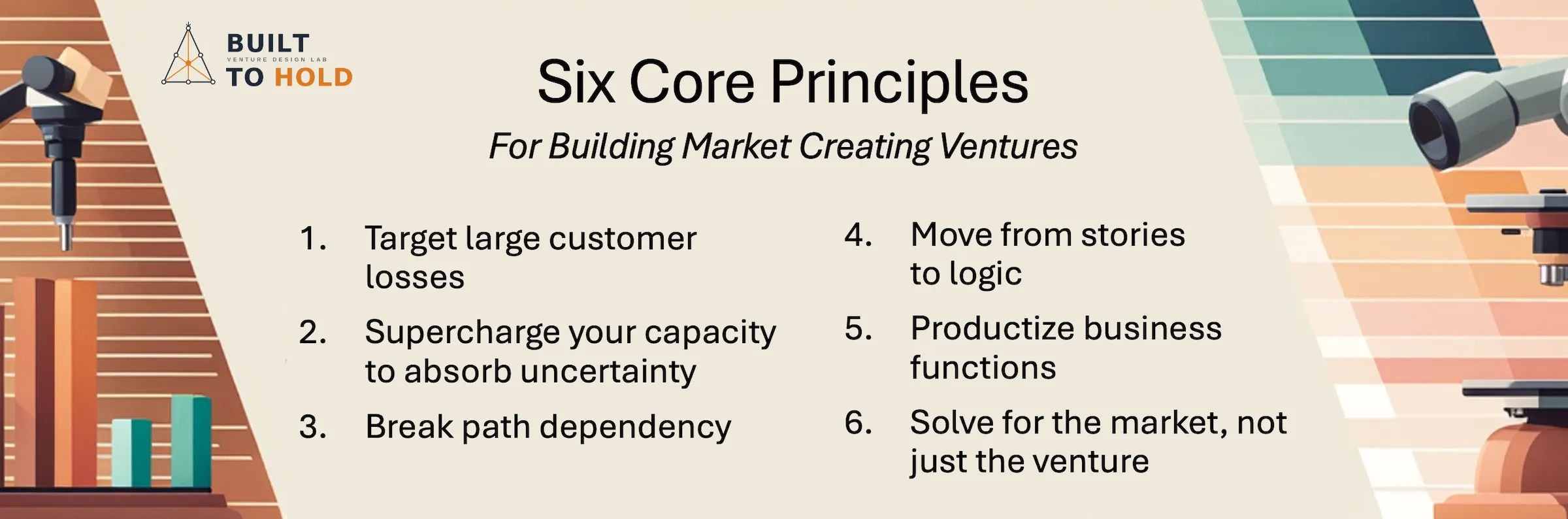
1. Target large customer losses - create fuel for market creation
New markets means creating entirely new routines, value propositions and customer journeys.
You won’t make those new routines and behaviors real unless you’re solving for a loss big enough to motivate meaningful change by your potential customers, at the level needed to make your venture viable.
In other words, addressing a large customer loss provides the necessary “fuel” a market creation venture requires. If the loss you focus on is too small, you’ll struggle to create a new market—and will likely end up competing in an established one with entrenched players.
When designing a venture, always work to succinctly describe the loss you solve and look for ways to rate and validate its significance to the customer.
2. Supercharge your capacity to absorb uncertainty - design a large margin of safety
Successful ventures don’t eliminate uncertainty—they’re built to withstand it.
The key is to design a startup that can remain profitable even under pessimistic operational assumptions, with a margin of safety to absorb the unexpected. It’s how the late Charlie Munger famously thought about investing.
This starts by screening the opportunity space for your venture to remove opportunities that have little chance to generate the cash flows you’ll need, and then seeking out ones with the greatest venture margin: the delta between what your customers will credibly pay and the fully-loaded unit costs you will likely incur.
A robust venture margin is your engine for resilience and growth, which your venture will need to maximize via approaches like productization (see #5 below).
3. Break path dependency - invent a new game, not a better one
To create new customer routines, you must actively break from existing paths. It’s instinctual to anchor on familiar models (“we’re the Uber of lawnmowers”), but doing so traps you in the same constraints as incumbents—without their advantages.
And in doing so, you just won’t get the efficacy you need.
Instead as Reid Hoffman said: “Don’t try to beat the competitors at their own game. You have to invent a new game—and master it.”
With FIT Startup, we start by identifying a “choke point”—a critical limiting operation that keeps existing solutions costly or inefficient—and design a strategy that eliminates it. Once that constraint is removed, we then identify which customer losses this new capability can solve. By explicitly removing a core factor of existing solutions, we effectively break the path dependency with the current approach, while simultaneously addressing a critical limiting factor.
As you design your venture, periodically rate how close your concept remains to existing approaches. If it feels familiar, you probably haven’t broken the path enough.
4. Move from stories to logic - objectively build and assess your venture
Entrepreneurs often live by stories—compelling narratives that win investors, talent, and early partners. But a good story doesn’t guarantee sound logic underneath. Worse, without logic as the centerpiece of your efforts, you risk convincing yourself of something that isn’t true.
When designing new market ventures, it’s critical to move from creating and debating narratives to building and analyzing logic models. Logic models let you analyze, test, and debate assumptions—something a story can’t do.
Logic models should make the efficacy of your strategies and their financial impacts clear. For example, rather than just claiming a first-mover advantage, instead model what actual advantage being first gains you, why that advantage works and how much it would realistically cost to overcome.
FIT Startup uses multiple models to represent a venture—for the required strategies, customer journey, resourcing and financials needed to make the venture work—but even just representing your venture as an equation to be solved, and determining the key variables and how they must perform, can significantly improve your venture building efforts.
5. Productize business functions - let the product power the business
The most effective ventures use the product not just to meet customer needs but to perform core business functions—reducing costs while increasing value.
Altering the form of the product itself to solve core operations of the business—across making, selling, delivering and getting paid for the product—can significantly lower the burden on business operations. This shifts your venture performance curve and increases your venture margin: i.e. your venture’s margin of safety and your ability to absorb uncertainty per #2 above.
Elegant productization not only drives down costs but often enhances customer value. Curves gyms, for instance, used a peer-led circuit model that cut staffing costs while deepening members’ sense of community and belonging.
Finally, effective productization involves integrated strategies, not add-ons. Any time you find yourself saying something like “we’ll just run ads or have marketing handle customer acquisition”, stop and examine how you could redesign your product to enable or handle that function more effectively.
6. Solve for the market, not just the venture - design at-scale viability
Successfully creating a new market requires you to think at the market-level, not just about your firm. This requires two key considerations: unlocking the core strategies that will make the market viable (for all firms), and envisioning the market and your venture at-scale.
Unlocking core strategies is the work of a core business architecture:
“A core business architecture can be likened to the DNA of a market: a handful of deeply intertwined requirements and strategies that determine the basic shape of the product and operations for all competitors and—most critically—set a cost floor and customer value ceiling for all their business models.”
You can read more about business architectures via the link above, but ultimately you need to consider the strategic logic that would make the new market work. Much like how balancing the concepts of lift, thrust, drag, and gravity determines if a flight solution is viable or not.
Meanwhile, envisioning your venture at-scale isn’t about dreaming of a billion-dollar valuation; it’s about identifying what would need to be true for that scale to be possible.
This helps you prioritize opportunities that support your desired level of scale, focus on designing and validating what you need to achieve that scale, and ultimately avoid dead ends and costly pivots.
Years ago, Odwalla founder Greg Steltenpohl shared his experience on this with a group of founders I was a part of: “You’ve probably imagined raising two or three rounds of funding—but what about seventeen?”
Each Odwalla market expansion required new financing to cover the cost of production and supply chain build-out. Steltenpohl related how when he later founded Califia, he applied at-scale thinking early—bringing on investors who were also partners that could solve the costliest operational challenges.
Engineering market viability
Market creation isn’t just about innovation—it’s about engineering viability where none exists yet.
These six principles shift the entrepreneur’s lens—from building a product to engineering a market. Applying them systematically can make the difference between incremental innovation and the creation of an entirely new economic space.
Want to learn more?
Stay tuned for upcoming webinars and workshops in the lab where you can dive deeper. Or reach out and get in touch!