“Premature optimization is the root of all evil” - Donald Knuth, Turing Award Winner
An all too frequent pitfall in venture building is pushing to solve a customer need before confirming commercial viability. That path often leads to dead ends—markets where customers can’t (or won’t) pay enough—leaving founders stuck with endless pivots or unsustainable business models.
Think of Webvan, Blue Apron or WeWork: ventures that found product/market fit, but in opportunity spaces that could never support the required customer price to be profitable.
For founders and corporate innovators, this results in endless pivots, spiraling burn rates, and getting trapped in “beachhead markets” with niches too small to sustain scale or ones where the economics just never manage to work out, no matter how big the venture grows.
For investors, it means betting money on ventures that never had a chance of generating meaningful returns—no matter how compelling the team or their story.
To avoid this trap and to establish a firm financial foundation, it’s critical to first screen the “venture search space” for opportunities with the highest profitability potential, so you can focus on ones with the greatest commercial viability and ignore ones that are costly dead ends.
The goal is to find the biggest problem, the biggest customer loss you could credibly solve for, in order to generate a large enough and promising enough opportunity space in which to define your venture.
By taking this step, our research has shown that you drive two critical outcomes:
-
Eliminating otherwise avoidable pivots, along with the associated cost and time, and
-
Defining and quantifying use cases with high probabilities of success—i.e. reaching positive cash flow—while decreasing the time needed to achieve it.
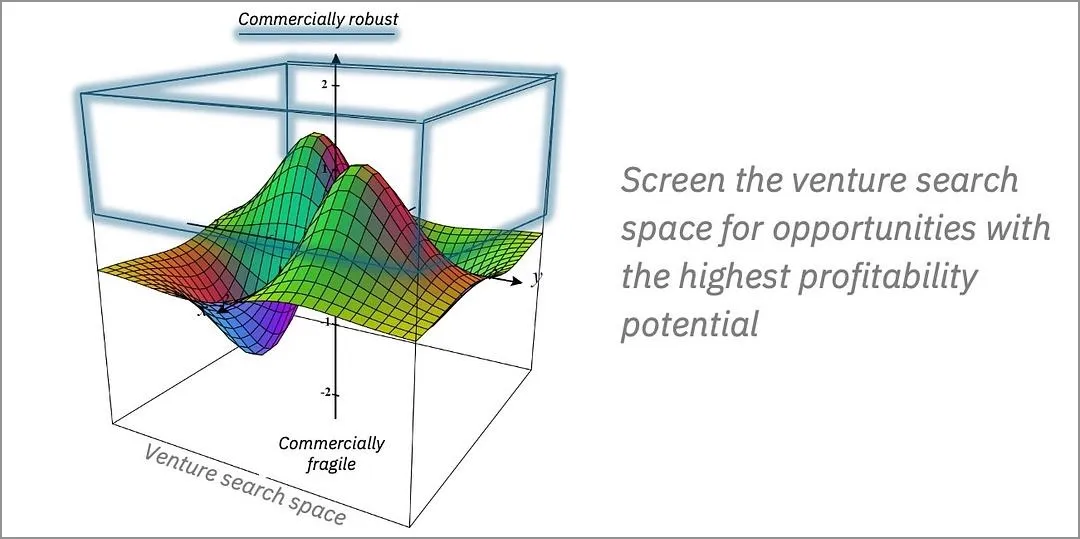
In the Build to Hold Lab and with FIT Startup our approach to this critical screening task is by isolating your Prime Commercial Opportunity. A Prime Commercial Opportunity (or PCO) is the broad use case or opportunity space that can most credibly generate the cash flows needed at-scale to pay back the required investment at a competitive rate of return.
The process for isolating a PCO generally takes 1-2 weeks and consists of four parts:
-
Defining your investment requirements (return, geography, industry, timeline) for the venture to achieve scale
-
Abstracting the core functionality of your innovation—or right-sizing the core problem if starting from a societal challenge
-
Generating and identifying potential use cases for the core functionality or impact cases from solving the core problem
-
Modeling the at-scale revenues needed by those cases to pay back the investment, and calculating the required price you would need to charge customers
The result is a series of use cases with explicit financial assumptions and requirements that can then be analyzed and reviewed for credibility. The most credible use cases become your candidates for your Prime Commercial Opportunity.
You can further reduce this to a single opportunity by selecting the most credible candidate, or if there are multiple candidates with comparable credibility, choosing that one that best matches your purpose or mission for the venture.
Whether you’re a founder, corporate innovator, or investor, isolating the PCO is a structured, financially-focused approach to avoid chasing opportunity spaces that were never viable to begin with.
Want to learn to screen the venture search space for your next venture?
If you want to learn more about how to isolate the Prime Commercial Opportunity for your venture, look out for an upcoming online course and tools the Built to Hold Lab will be launching. Or reach out to us in the meanwhile.